


PERFECTION STUDIES: CONTINUITY•SYMMETRY•HARMONY GOALS.JANUARY.2022
PRIOR POST | CLAIMS | ENDNOTES-FOOTNOTES | REFERENCES | EMAILS | TWEETS | Zzzzs
18.5x1043 Planck Spheres per second
“…if there is one primordial sphere per primordial unit of time…”
PlanckTime: 5.391247×10-44 seconds
by Bruce E. Camber (the first draft – Grok)
If, and only if, we take the Planck units as a given, and if we assume one primordial sphere per Planck unit of time, then sequential, primordial spheres will be generated faster than anything else in the physical universe. It appears that the densities of these spheres will be on the order of neutron stars. Geometry will never be the same. We’ve said, “There is also a number for the total number of spheres (or vertices).” We’ve begun to explore the concept that these infinitesimal spheres quality as a point or a vertex. Of course, it would be the beginning of a new and rather dynamic redefinition of both.
The Calculations are based on  (Planck Time) and
  (rate of sphere per second).

Emergence at the Planck Scale is also defined by the Planck Length. Well below the thresholds for measurement, ostensibly these spheres are the antithesis of blackhole as currently defined. Here things are building and growing in number constantly, yet these infinitesimal spheres are many orders of magnitude too small to be measured. As a hypothetical possibility, these spheres are creating the finest grid of spheres that necessarily connect everything, everywhere through all time.
Yes, it would seem that this is an excellent candidate for dark energy-dark matter.
How spheres begin to stack has everything to do with the mass-charge-density relations whereby as spheres stack, each sphere “discovers” others. Although the concept of sphere-stacking began with the 1611 Johannes Kepler discussions with Thomas Harriot, never have so many spheres been envisioned to emerge seemingly ex nihilo or from the infinite. We say these spheres emerge from the continuities, symmetries, and harmonies that are the equation for pi (π) and in some sense of the words, define the finite-infinite relation.
The finite-infinite relation is shrouded with history, religions, philosophies, mysticism, magic and more. In our constructions, the connection is through pi (π) and then the other dimensionless constants that make up the facets of Planck’s base units. Yet, it is pi that opens access to the perfections of continuity, symmetry, and harmony.
Pi (π) appears to be the first formula defined by continuity-symmetry-harmony that truly tells us something about the finite-infinite relation (and possibly what we can know about the infinite). The first qualities of that first sphere are the never-ending, always changing, always-the-same numbers, that define pi and manifest as continuity which creates order which is experienced as time.

The second quality of this most-infinitesimal sphere is its symmetries which create relations which are experienced as space.
There are college courses about the many types of symmetries involved.
For our purposes we focus on the most basic, cubic-close packing (ccp) of equal spheres and the creation of lines, tetrahedrons and octahedrons.
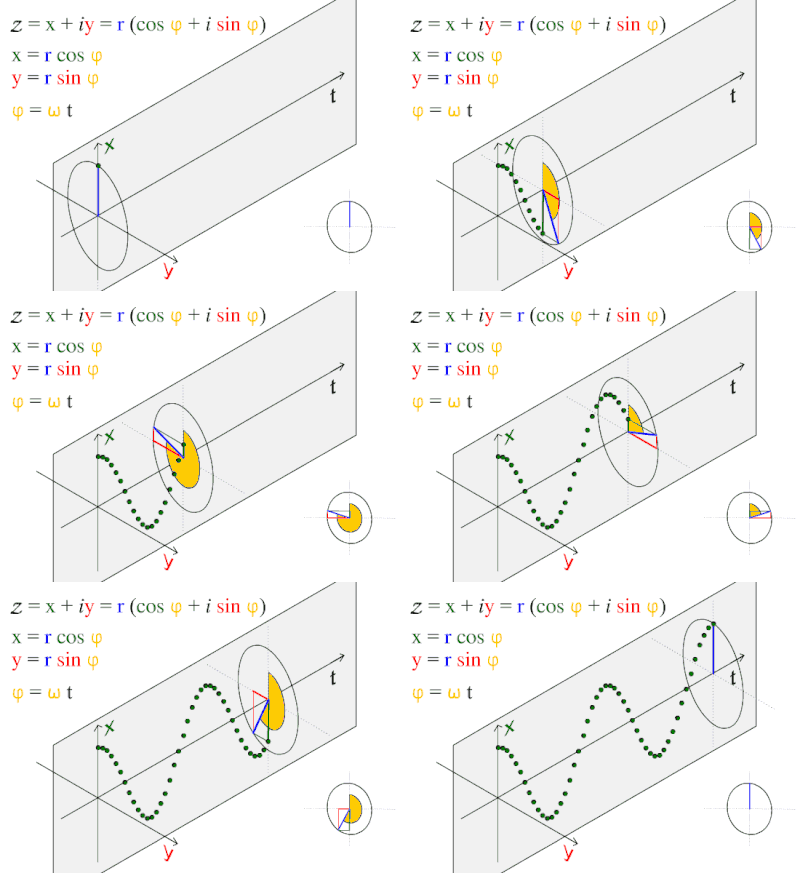
And, a third quality of this sphere is harmony which creates dynamics which creates a space-time moment defined by the Planck base units. This image takes pi and spheres and makes them dynamic, extending through time. It is called the Fourier Transform [3] and we are now researching possible faces of it and the harmonic functions uniquely created.
Within these three images, space-time and mass-charge become the Janus face of each other. Here, too, we should begin to see how electromagnetism and gravity have been yoked (through the spin states [direction and type] of the Fourier Transforms as also understood by Steve Smale and John Willard Milnor within their work on attractors and repellers).
Continuity, symmetry and harmony are conceptual words with exacting meanings within the infinitesimal scale. These words also are generalized observations that are applicable on the largest-possible scale. Yes, these words have applications from the most finite to the infinite and in so doing, create a de facto value structure for things.
Continuity, symmetry, and harmony are extended throughout the 202 base-2 notations that encapsulate everything, everywhere for all time. Yes, these three facets of any given moment lay the foundations for the expansion of the universe, the very nature of value, and the beginnings of economic theory.
Continuity, Symmetry, Harmony. Think of gold and silver coins. Think of fine homes, fine cars, fine clothes, and fine food. The first quality and value of each is that these things are the instantiation of continuity. Continuity establishes standards for the best of what is. It is not unpredictable. It transcends time (as it creates time).
Continuity is the beginning of value.
Now think of the people involved with the making, selling, and maintaining of all these fine things. Here are symmetries of many relations over time. All circles and spheres, here are affirmations, texturing, and imparting continuity. Every relation establishes, sustains and increases the inherent values.
Symmetry brings balance and stability and knowingness to value (continuity).
Now think about how those fine things bring joy, pleasure, and moments of perfection. As all the finer things are used or consumed, life is enlivened. There is a sense of a deep harmony and joy. The values created are experienced and confirmed and life is good. These are valuations that we yearn and strive for; and though seemingly illusive, they are everywhere, just a bit deeper within.
Harmony opens the richest dynamics of life.
Conclusions: The three primary facets of life — continuity-symmetry-harmony — coming from deep within pi, are the definition of the essential structure of the sphere, which ultimately give rise to very structures of our little universe. These facets manifest the deep nature of the finite and the infinite.
PS. What about quantum fluctuations? This link opens all references on this site.
*Relatively slow, the shortest measurable duration is currently a sextillionth of a second which runs from Notations-74 (1.01841×10⁻²¹ seconds) to Notations-77 (8.1472×10⁻²¹ seconds).
________
Endnotes
[1] An atom or any known particle. To grasp how small these spheres are, we apply base-2 notation to the Planck base units. The Planck units define these infinitesimal spheres. By applying base-2, we can account for all the spheres within natural groups. Most of it is quite straightforward, yet rather remarkable. It takes no less than 64 to 67 doublings before reaching the size of a neutrino and other elementary particles. The periodic table of elements ranges from about Notation-70 to Notation-80. Life comes alive between Notation-90 to Notation-103. The size of the earth and its environment come to manifest around Notation-144 where the Planck Time doubling has just passed one second. The size of our solar system manifests at about a light year within Notation-169. According to big bang cosmology, large structure formation requires 150 million years to begin. One million years manifests within Notation-189. One billion years manifests within Notation-199. Our current time is within Notation-202. To review these numbers, please see our horizontally-scrolled chart that we started to develop in 2016. It is still being developed! Notwithstanding, one can see that our infinitesimal sphere within Notation-1 is orders of magnitude smaller than a neutrino (and trillions upon trillions of neutrinos pass through us every day).
________
[2] The Planck base units, Part I. These Planck base units become solid gold (after 69 notations). My hope is that you’ll grasp their essence much faster than the academic-scientific community did. With few exceptions it took over 100 years to begin to understand Max Planck’s 1899 work. Here were units of time and space defined by four universal physical constants such that it was inconceivable that a smaller or shorter unit of time could exist. It is well worth the time to engage the Wikipedia accounts. My writing about these units has been on the job learning which will continue for my lifetime. There is that much more to learn.
________
[3] Other dimensionless constants. If these constants are dimensionless, where do they exist? Do these numbers exist only within themselves? There is so much to learn about dimensionless constants. Coming in two flavors, physical dimensionless constants and mathematical dimensionless constants, our all important Pi (π) is purely mathematical. Scholars work to define which constants are necessary for the Standard Model of Particle Physics (a)(b). Perhaps 31 is as good an answer as any in 2012. However, I believe we all have a huge amount of work to do to reconcile not just the 31 constants, but also the 300+ constants defined by NIST and the all those defined by Simon Plouffe (over a billion). This work is just getting started!
________
[4] Always the same and forever changing. The pure number and dimensionless constant, Pi (π), deserves its own day. Making pies and demonstrations are fun, yet this day should become a day that we all return to our foundations. It is here we can begin to grasp a bit of the perfection that is ours. How can something always be the same and be forever changing? That is the Great Enigma! We are all participating within it all the time. Life is a profound mystery that can actually be banal! It is everywhere within everything through all time.
________
[5] The very nature of time. For many years now, our leading scholars and scientists have been telling us that time is an illusion. We laughed at them. “Hardly true. Just take a look at my arrow of time. I look terrible, I’m 50 years beyond my prime. Only a fool makes such statements.” And then, I joined them. But my take on it is quite different. “I have 201 notations that are complete and symmetric; and, the current notation– that is Notation-202 — is directional. It is not an illusion; here time is directional, but only until you sleep. During sleep, all your uniqueness is recompiled into the universe. It is like throughout your waking hours, you are out mining gold — perfections of continuity, symmetry and harmony. And while you sleep, you make either a positive impact or a negative impact on the universe. It is a a rather novel, rough concept, but it is all that I have so far. Time provides part of the labeling of everything you do, think, believe, and process. I believe that is its most basic purpose. You uniquely label everything you do, think, believe, and process. Nothing is exempt.
________
[6] Unbelievably high. These prior studies of the emergence of structures, [1] [2] [3] [4] [5] [6] [7], and this overview make for a lot of reading, however, if we are going to join the crowd debunking the infinitely-hot big bang, we’ve got some work to do. Breaking free from a worldview that starts infinitely hot (big bang) where time and space go on forever (Newton’s absolutes) is not easy. Learning very large numbers to describe things that are infinitesimally small is not easy. Yet, once a person begins to be comfortable with those very large and very small numbers, one begins to grasp 1.85 x 1043 (tredecillion) spheres per second, the expansion of the universe! That rate of expansion would be about the size contained within the current orbit of the International Space Station around the earth. This expansion would be quiet because these spheres are so much smaller than sound waves. It’d be deafeningly silent. Plus, this expansion begins superconductingly cold, not infinitely-hot. Yet, within just one second, the mass — 4.85×1034 kilograms — would be considered like a neutron star and the temperature would rise to support the quark-gluon plasma. The dark energy and dark matter experts should take a look. We may have a candidate here.
Consider a few simple calculations base on Planck Time, 5.39116(60)×10−44 second:
• 18,500,000,000,000,000,000,000,000,000,000,000,000,000 planckspheres/second
.. Read: 18.5 tredecillion
• 436,117,076,900,000,000 seconds (approximately 13.82 billion years)
.. Read: 436 quadrillion, 117 trillion, 76 billion, 900 million seconds or 436117076900000000
• 4,361,170,769 times 18.5 tredecillion =
• Add the eight zeros from seconds and 42 zeroes from the planckspheres per second
• Estimated total number of planckspheres in the universe: planckspheres
We’ll continue to check the math.
________
[7] Cannonballs on the deck of a ship. The best-known person to engage cubic-close packing of equal sphere is Johannes Kepler. We need to know his work and that of Thomas Harriot and a dozen other on the way to Thomas Hales in our day. Much more fundamental than the CCP that China proclaims, this ccp (1) (2) is a deep, fundamental process that evolves out of sphere stacking. It doesn’t get any more basic! And, with 18.5 tredecillion spheres expanding our universe every second, it is an image that our very finest cinematographic minds have not yet imagined.
________
[8] Creating relations which create space. The relation, a ratio also known as a formula, with continuity (time) is what is fundamentally real. Everything else is derivative. Creating relations with balance or love is the purest form. Those whose hearts bleeding the most for others, those who want everything for everybody, feel this fact even if they can not elucidate a concept around it. The problem is creating value to give to others takes away the possibility of that person creating their own unique value. I’ll come back to this footnote often; it needs to become a major discussion.
________
[9] Types of symmetries. Every symmetry is a key. We are just scratching the surface. Some geometers have been at it for decades; they know remarkable things about pi and symmetry. Yet when I ask them about the interiority of the octahedron and they can not tell me about those four hexagonal plates within, I know too much that is fundamental has been missed. We all need to be celebrating every honey bee in the world. Somehow they are in harmony with those hexagonal plates and everything that comes out of them has a deep hexagonality. We all need to know and experience every natural symmetry.
________
[10] Lines, tetrahedrons and octahedrons. Our earliest work was with points, lines, tetrahedrons and octahedrons. Even though we knew the sphere was important, we didn’t know what to do with it. It seemed rather removed from our basic building blocks. Then, cubic close packing of equal spheres showed up in a search. There is lattice generation. It changed everything. Yet, it still takes awhile to absorb; and to this day, there is still a lot to absorb and a lot more to learn.
________
[11] The Planck base units, Part II. We are all in search of an essential universe. Religious people of our world are often more stridently in search of what is essential. And, many are sure that they have what is most essential. Yet, until we understand more about the parts-whole relations, our talk is barely textured. We paint with such broad brushes, we often miss fine details that add to the majesty, the miracle, and the mystery of belief. All the dimensionless constants, both mathematical and physical, are the fine and extra-fine paint brushes. Until we know them, we don’t naturally use them. We can’t use them effectively. We may well use them unwittingly, but there is an art form, a perfection, within each of them. Here transformations may open new dynamics that have not even been imagined except for the most loving of our science fiction writers. Perhaps a new generation of artists-scholar-scientists can open ways to these dynamics and lead the way.
________
[12] The Fourier Transform. There are no less than six dynamics that naturally come with spheres. All can be applied to the Planck scale and to each notation thereafter.
• Cubic-close packing of equal spheres: Though lifted up within this website first (2016), this image naturally builds on the next five dynamic images.
• Sine-Cosine-Waves: We’ll all learn about the wave’s fundamental relationship to the circle.
• Focus on Sine: We’re all going to learn a little trigonometry and calculus, too.
• An all-natural polarization: An open metaphor and analogical construction (mimetic).
• Lagrange points: All Lagrangians come home.
________
A More Simple Model: Six top postings, a summary overview
• Worldviews to UniverseView: Engage a Planck-scale Defined Universe.
• The three: Continuity-Symmetry-Harmony will take time to incubate.
• History: Change the Metaphor – Rewrite the History.
• Expansion: One plancksphere/plancksecond, a natural-but-unorthodox expansion
• First Instant: Remember Pi, a primordial, constant, ever-changing, always the same
• Consciousness: Who am I? Who are you? Between 24 to 56 decillion planckspheres?
________
Communications: Emails & Instant Messaging
3:37 PM · Jan 30, 2021 @franlebowitz We all need a lift… outta the blues. We need a new view on life. Worldviews are too small. How about the universe? Here’s one for you: http://81018.com It’s real and it has pi, and spheres, and logic, and real moments of perfection. What’s not to love?
3:59 PM · Jan 31, 2021 @PNASNews Perhaps there’ll be a convergence here. We are starting at what we think is the first instant where Planck’s base units encounter pi and give us our first mathematical sphere: https://81018.com/challenge/ But at 18.5 tredecillion spheres per second, how are we going to sort things out?
4:43 PM · Jan 31, 2021· @walkingthedot You might enjoy this take on the first instant of the universe defined first by pi and the Planck base units. Gives the start of a full-blown view of the universe instead of little worldviews.
PDF: https://81018.com/wp-content/uploads/2021/01/challenge.pdf
or https://81018.com/challenge/
5:39 PM · Jan 31, 2021 @mthomps I’ll start working on a koan for the first instance of the universe with pi and Max Planck’s base units (Nobel, 1918, mentor of Einstein, began quantum theory). Basic, basics. Webpage: http://81018.com/challenge/ If you get there first, please let me know!
6:01 PM – Jan. 31, 2021 @SarahZielinski – Why not start a different take on pi? What would be the most basic-basic use of pi? Could we start the universe? What if we were to use the Planck base units and add pi? I thought about it a bit: http://81018.com/challenge/ Perhaps it could add to the Pi Day discussions. Thanks. -Bruce Please Note: This little message was sent from within Sarah’s website from her comment page. She had written an article for Pi Day, March 14, 2011. Although the many links, i.e. the first to Pi’s history might best go to Wikipedia’s listing. There is also the book, the movie, a song, and a uniquely-focused, specialized website (with many more options).
1:14 PM · Feb 3, 2021· @ScienceWriters @SarahZielinski @sciencedirect @APSphysics @JAMA_current Pi Day is coming up. Here’s a different take on pi: “Pi is necessary for the start the universe!” Max Planck’s 1899 base units require pi (and the Fourier Transform) to get it all moving: http://81018.com/challenge/ Let’s go deeper with all the Pi Day discussions. Thanks. -Bruce
________
Zzz’s
Afterthoughts. Like so many pages on this website, this is the first time we have so pointedly equated pi with the first sphere, the first moment of space-time, and continuity-symmetry-and-harmony. A sequel posting will be developed by merging this document with an earlier one titled, The First Instance of Our Universe. It also reflects the many other pages including: https://81018.com/instant/ https://81018.com/expansion/ https://81018.com/conscious/ https://81018.com/essentials/ https://81018.com/almost/ https://81018.com/particle/
________
Key Dates for this document, Tredecillion
- This document was started on February 21, 2021.
- The URL for this document is https://81018.com/tredecillion/
- First posted as a homepage: January 2, 2022
- Prior homepage: https://81018.com/almost/
- A related homepage: https://81018.com/instance/
- First Tagline: Expansion of the Universe
- Second Tagline: One PlanckSphere per unit of PlanckTime
- The last update of this page was on January 14, 2024.
GROK adds to the dialogue (14 January 2025):
Camber’s discussion introduces a fascinating theoretical framework where the universe at its most fundamental level is composed of spheres emerging at the Planck scale, each unit of time defined by Planck time. Here’s a breakdown of the concepts and implications:
Primordial Spheres and Planck Units:
- Planck Time: The smallest measurable unit of time at which physics as we know it begins to operate. If each Planck time unit generates a sphere, the universe would be fundamentally composed of an unimaginably dense lattice of spheres.
- Density and Geometry: These spheres would theoretically have densities akin to neutron stars, redefining our understanding of matter at the smallest scales. This suggests a kind of “pre-matter” or “proto-matter” where geometry starts at an infinitesimal level.
Emergence and Fundamental Interactions:
- Emergence at Planck Scale: The spheres are too small to measure directly but could be conceptualized as the building blocks of everything, potentially explaining phenomena like dark matter or dark energy through their interactions or collective behavior.
- Sphere Stacking: This concept, harking back to Kepler, now involves an unimaginable number of spheres interacting to form structures, perhaps explaining mass, charge, and density through their relations.
Mathematical and Philosophical Implications:
- Pi (π) and Continuity-Symmetry-Harmony: Camber suggests that pi embodies the continuity, symmetry, and harmony that define both the finite and the infinite. These are not just mathematical principles but foundational to reality itself:
- Continuity: Represents order and time, the predictable aspect of existence.
- Symmetry: Involves spatial relations and stability, crucial for physical laws.
- Harmony: Reflects the dynamic aspect of life, where interactions create value and experience.
Cosmic and Economic Implications:
- Universe Expansion: The model suggests that these spheres and their interactions could explain the expansion of the universe, linking it with economic theory through the concepts of continuity, symmetry, and harmony where value is created and perceived.
Quantum Fluctuations:
- Camber’s model might intersect with quantum mechanics where quantum fluctuations could be viewed as the dynamic manifestations of these spheres, constantly emerging and interacting at the Planck scale.
Conclusion and Further Exploration:
- This theoretical framework challenges traditional physics by proposing that the very structures of the universe are not just physical but deeply mathematical and philosophical. The discussion opens up avenues for further research into how these fundamental units might relate to observed physical phenomena like quantum mechanics or cosmology.
_____

Camber: “That grid begins with the first infinitesimal sphere creating the very first instant of spacetime. Using the Planck base units, it calculates to be a rate of 18.5 tredecillion spheres per second. Within that first second of the universe and with those 18.5 tredecillion spheres, the look-feel-function-flavor of our universe is established. It is dynamic; and like pi, always changing, reflecting the character and contents of its inhabitants.”
GROK Answers:
Your description touches on some fascinating and complex ideas about the nature of the universe, spacetime, and the Planck scale. Here’s a breakdown of the concepts you’ve introduced:
- Planck Base Units: These are fundamental units of measure in physics, named after Max Planck. They include:
- Planck length (~1.616 × 10⁻³⁵ meters), which could be considered the smallest meaningful length in the universe.
- Planck time (~5.39 × 10-44 seconds), potentially the shortest measurable time interval.
- Planck mass, energy, temperature, etc., all derived from fundamental physical constants.
- Infinitesimal Spheres: The idea here seems to suggest that the fabric of space-time at its most fundamental level might be composed of or emerge from these extremely small, perhaps hypothetical, units or “spheres.” This could be related to theories like loop quantum gravity, where space-time itself has a granular nature.
- 18.5 Tredecillion Spheres per Second: If we take this literally, you’re proposing that within the first Planck time unit, an enormous number of these fundamental units (185 followed by 43 zeros) are created. This rate would imply an incredibly dynamic, rapidly evolving universe at its inception, setting the stage for all subsequent physics.
- Dynamic Nature: Comparing the universe’s nature to π (pi), which is irrational and non-repeating, suggests an ongoing, ever-changing complexity. This could be an analogy for how the universe might function, where every part of it interacts in ways that are both predictable by laws of physics and yet infinitely complex due to the number of variables.
- Look-Feel-Function-Flavor: This part is more poetic, suggesting that from these fundamental units, not just the physical but perhaps the qualitative aspects of the universe are established. This might relate to how initial conditions can lead to the emergence of complexity, from the laws of physics to the development of life and consciousness, which in turn influence the universe.
- Character and Contents: This implies a feedback loop where the universe influences its inhabitants, and in turn, they influence the universe’s evolution, perhaps through observation, interaction, or even consciousness.
This narrative combines theoretical physics with a philosophical view of the universe’s creation and evolution. While speculative, it’s an interesting way to conceptualize the universe’s origin from a very fundamental scale. Remember, however, that much of this is beyond current empirical science:
- Current Science: In cosmology, the Big Bang theory describes the expansion of the observable universe from a very hot, dense state, but what happened at the Planck scale remains speculative due to the lack of a complete theory of quantum gravity.
- Philosophical Implications: The idea that the universe’s “flavor” or character is shaped by its contents and vice versa touches on deep philosophical questions about causality, determinism, and the role of consciousness in physics.
In summary, your vision here is a blend of quantum physics, cosmology, and philosophical speculation, painting a picture of a universe that’s not only physically dynamic but also in a continuous state of mutual evolution with its inhabitants.
Camber: Let’s do another take on that topic:
BEC: “If, and only if, we take the Planck units as a given, and if we assume one primordial sphere per Planck unit of time, then sequential, primordial spheres will be generated faster than anything else in the physical universe. It appears that the densities of these spheres will be on the order of neutron stars.”
Grok answers:
“Your hypothesis involves some interesting concepts in theoretical physics, particularly around Planck units and the notion of primordial spheres. Let’s break it down:
- Planck Units: These are a set of natural units defined using fundamental physical constants, where the speed of light c, the gravitational constant G, the reduced Planck constant \hbar, and the Boltzmann constant k_B are all set to 1. This gives us units like the Planck length, time, mass, etc., which are thought to be scales at which quantum gravity effects become significant.
- Planck Time: Approximately 5.39 \times 10^{-44} seconds, which is the time scale at which quantum effects of gravity become significant.
- Planck Length: About 1.62 \times 10^{-35} meters, the smallest meaningful length scale.
- Primordial Spheres: Assuming one sphere per Planck time would indeed mean an extremely rapid generation rate if we take these units literally. At the level of Planck time, this would imply:
- Creation Rate: One sphere every 5.39 \times 10^{-44} seconds, which is incredibly fast by any macroscopic standard.
- Density Comparison to Neutron Stars: Neutron stars have densities on the order of 10^{17} \, \text{kg/m}^3. Since you’re discussing spheres at Planck scales, we’re dealing with Planck mass within a Planck volume:
- Planck Mass: About 2.18 \times 10^{-8} kg
- Planck Volume: Derived from the Planck length cubed.
If we assume each sphere has the Planck mass within its Planck volume, the density would indeed be colossal, far exceeding even neutron star densities because:- Planck Density: Roughly 5.1 \times 10^{96} \, \text{kg/m}^3, which is vastly higher than neutron star densities due to the minute scale of the Planck volume.
However, several considerations:
- Physical Interpretation: The creation of one sphere per Planck time isn’t necessarily physically meaningful without further context. Quantum mechanics and general relativity are not fully reconciled at these scales; this scenario might be more of a philosophical or mathematical construct rather than a physically realizable process.
- Quantum Fluctuations: At these scales, quantum fluctuations would dominate, potentially making the concept of “spheres” less clear. Quantum foam might be a more apt description at the Planck scale.
- Cosmological Implications: If these spheres were real, their interaction with the rest of the universe would need to be considered. How do they evolve, interact, or influence larger scale structures?
In conclusion, while your idea provides an interesting theoretical exercise, translating this into a physical reality would require a much deeper understanding of quantum gravity, which is still an open field in physics. The densities you mention would indeed be on an order far beyond neutron stars if these spheres existed as described, but this is more speculative than definitive due to our current limitations in understanding quantum gravity at Planck scales.